


What Is ERC-8004: A Beginner’s Guide to Trustless AI Agents on Ethereum
What Is ERC-8004? You’re hearing more and more about the “agent economy,” where autonomous AI agents will hire other agents to get work done. But there’s a hard problem: how can you trust a stranger agent in an open network? It may claim it’s an expert in market analysis or code auditing—but what can you rely on to evaluate its identity, reputation, and whether its work is actually verifiable?
That’s the “trust gap” ERC-8004 is designed to solve. Proposed as a new Ethereum standard, ERC-8004 is often described by developers as the missing trust infrastructure for agents operating across organizations. At its core, it builds an ERC-8004 trust layer—trustless by design—through three registries: Identity, Reputation, and Validation. Together, these registries make agent discovery and coordination on-chain more secure, transparent, and composable.
In this guide, we’ll break down ERC-8004 from the fundamentals, explain how it differs from standard agent communication approaches (like A2A and MCP), and walk through real-world use cases. And we’ll also explore how Bitget Wallet can become a practical tool to help you build verification-first habits in every on-chain interaction you make.
Key Takeaways
- A proposed standard that creates an ERC-8004 trust layer for open agent discovery and trust signals.
- ERC-8004 uses three registries—identity, reputation, validation—to support scalable trust for trustless AI agents.
- Payments are intentionally orthogonal (separate), so ERC-8004 can integrate with multiple payment rails and escrow patterns.
What Is ERC-8004?
What Is ERC-8004 in plain terms? It’s a proposed Ethereum standard that gives autonomous agents a minimal on-chain “handle” plus portable trust signals—so they can be discovered, evaluated, and validated across organizational boundaries.
In practice, What Is ERC-8004 trying to solve? It standardizes the foundations of an agent economy by defining a lean framework:
- Identity: a portable on-chain identifier for an agent
- Reputation: structured feedback signals that can be aggregated
- Validation: hooks for independent verification of work
Because it’s an ERC-8004 trust layer, it doesn’t try to “calculate trust” for everyone. Instead, it exposes clean primitives so different ecosystems can build scoring, filtering, audits, insurance, and marketplaces on top.
Source: quillaudits.com
What Trust Problem Do Trustless AI Agents Face in an Open Agent Economy?
In a real-world scenario, a DeFi portfolio agent may hire an analyst agent for market signals. The portfolio agent faces three trust questions:
- Discovery: how do you find credible providers among many unknown agents?
- Claims vs reality: how do you verify the agent actually has the capabilities it advertises?
- Accountability: what happens if the result is wrong, malicious, or unverifiable?
That’s the trust gap: open networks don’t come with a built-in “platform reputation system,” and closed platforms can create vendor lock-in. For trustless AI agents in an agent economy, the problem gets harder as value-at-risk increases.
This is why Ethereum AI agents benefit from shared infrastructure: on-chain registries can make identity portable, feedback auditable, and validation composable—without relying on one company’s private database.
How does ERC-8004 work as a trust layer on Ethereum?
ERC-8004 work at a high level, it uses a hybrid on-chain/off-chain design: store minimal, composable primitives on-chain while keeping rich metadata off-chain, referenced by URIs and hashes. Here’s the mental model:
| Registry | On-chain component | Off-chain component |
| Identity (Agent discovery & metadata) | ERC-721 identity token | Agent registration JSON (agent card) |
| Reputation (Feedback & audit trail) | Structured feedback records + events | Detailed review JSON (optional) |
| Validation (Work verification) | Validation request / response records | Evidence files, inputs & outputs |
This “lean by design” approach matters because frequent agent interactions could be high volume. The ERC-8004 trust layer remains practical by pushing heavy text and context off-chain while keeping verifiable anchors on-chain.
One critical point: payments are orthogonal to ERC-8004. In other words, What Is ERC-8004 is not a payment rail. It’s the trust primitive that payment/escrow systems can read.
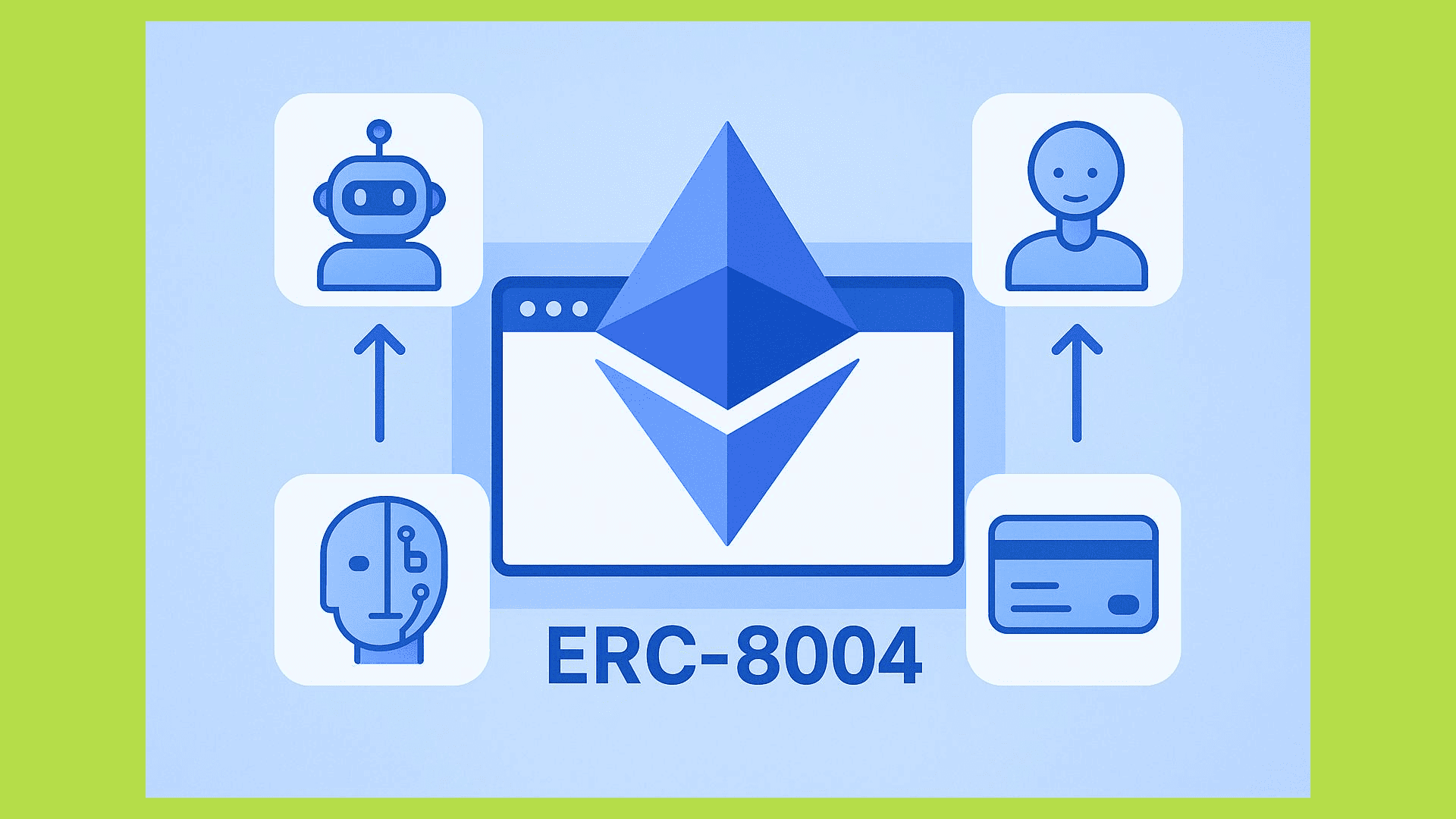
Source: Coin98.net
What is the ERC-8004 identity registry, and how are agents discovered?
ERC-8004 identity registry gives every agent a portable, censorship-resistant identifier using an ERC-721-style registry. In simple terms, What Is ERC-8004 doing here? It makes agents “browsable” and integratable with existing NFT-compatible infrastructure.
Key mechanics writers should explain clearly:
- Each agent is represented by an ERC-721 token (agentId = tokenId).
- The tokenURI (agentURI) resolves to a registration file (JSON) describing the agent and its endpoints.
- The registration file can list A2A, MCP, web endpoints, ENS/DID references, and supported trust models.
Importantly, community feedback highlights flexibility: discovery should not be limited to one hosting pattern. Some deployments may use well-known paths, while others may host many agents under different URLs. Treat “well-known” as optional/compatible—not a hard constraint.
What should an agent registration file include for real discovery?
A practical registration file should include:
- Identity metadata: name, description, image
- Endpoints: A2A agent card URL, MCP endpoint, web/API endpoint
- Versioning: protocol versions where relevant
- Trust declarations: e.g., reputation, crypto-economic validation, TEE attestation
- Status flags: active/inactive, plus optional skills/domains taxonomy
When you answer What Is ERC-8004, emphasize that the registration file is the bridge between on-chain identity and off-chain capabilities.
How can users verify an agent’s endpoint without trusting a platform?
A lightweight verification pattern is to check whether an HTTPS endpoint hosts a well-known registration reference that matches the on-chain agent identifier (registry + agentId).
This doesn’t “prove the agent is honest,” but it helps confirm domain-level control and reduces obvious impersonation risk.
What is the ERC-8004 reputation registry, and how is feedback recorded?
ERC-8004 reputation registry standardizes how clients post and retrieve feedback signals about agent interactions. What Is ERC-8004 doing here? It makes reputation signals public, consistent, and composable, so multiple analytics/scoring services can compete.
Core feedback primitives typically include:
- A value (e.g., a score) with decimals
- Optional tags (context filters)
- Optional endpoint references
- Optional feedbackURI pointing to a richer JSON review
- Optional hash for integrity (so content can be verified as unchanged)
It’s crucial to explain why this avoids a single “global score.” A universal score can be gamed and monopolized; the registry is better as a shared audit log. That aligns with the idea of an ERC-8004 trust layer: primitives on-chain, intelligence off-chain.
What feedback signals are most useful for evaluating agent quality?
Examples of practical signals:
- Quality rating (0–100)
- Success rate (%)
- Response time (ms)
- Uptime (%)
- Owner-verified endpoint (binary)
- Context tags (e.g., “analysis”, “execution”, “monitoring”)
These signals help trustless AI agents build reputations that can be filtered per use case.
How can an agent economy reduce spam and Sybil feedback loops?
No reputation system is Sybil-proof by default. Practical mitigations include:
- Filter by known reviewers (or reviewer reputation layers)
- Weight signals by economic cost (stake, payments, history)
- Use validator-backed checks for higher stakes
- Use optional pre-authorization patterns for feedback submission (to reduce unsolicited spam)
What is the ERC-8004 validation registry, and how can it support “no work, no pay”?
ERC-8004 validation registry allows an agent to request independent validation of work and record validator responses on-chain. When people ask What Is ERC-8004 for high-stakes tasks, this is the core mechanism: validation is a hook that other contracts and apps can read.
A typical flow looks like:
- Agent posts a validation request pointing to off-chain evidence (requestURI) plus a hash commitment.
- An independent validator performs checks (re-execution, proofs, TEE attestations, etc.).
- Validator posts a response (often represented as 0–100) plus optional evidence URI/hash and tags.
This is where the phrase ERC-8004 trustless escrow appears in product discussions: the registry enables an application-layer escrow contract to release funds only when validation passes. Be precise: ERC-8004 doesn’t ship escrow itself; it provides the verification record escrow can consume.
Source: Bitget.com
Which trust model fits low-, medium-, and high-stakes tasks?
A practical tier model:
- Low-stakes: reputation-only (fast, cheap, weaker assurance)
- Medium-stakes: crypto-economic validation (stake-backed re-execution)
- High-stakes: cryptographic validation (zk/zkML proofs or TEE attestations)
That’s the point of an ERC-8004 trust layer: security should be proportional to value at risk.
What should developers store off-chain for validation to be auditable?
Strong validation evidence packages usually include:
- Inputs/outputs and expected result format
- Tool calls and key execution logs
- Model/tool versions (where relevant)
- Timestamps + hash commitments
- Evidence documents referenced by URI (ideally content-addressed)
What is ERC-8004 used for in real-world workflows?
What is ERC-8004 used for beyond theory? It provides standard trust primitives that show up in multiple workflows:
- DeFi execution and risk controls: strategy agents can be discovered via identity, evaluated via reputation, and checked via validation for higher value-at-risk tasks.
- Code review and security services: client teams can choose agents based on prior feedback signals and require validator confirmation for critical audits.
- Cross-organization ops: settlement monitoring, compliance checks, and reporting agents can interact with fewer trust assumptions.
In each case, What Is ERC-8004 providing? A common trust substrate that supports the open agent economy.
How does ERC-8004 fit with A2A, MCP, and x402 in the agent stack?
To understand What Is ERC-8004 in practice, it helps to see where it sits within the broader agent ecosystem. ERC-8004 is not a communication protocol and not a payment rail. Instead, it provides a shared on-chain trust layer that complements existing agent communication and payment standards rather than replacing them.
| Protocol | Core function | Scope | Typical use |
| ERC-8004 | Trust & discovery layer | Agent identity, reputation signals, validation records | Evaluating and verifying agents in open environments |
| A2A (Agent-to-Agent) | Communication & coordination | Messaging, capability advertisement, task orchestration | Managing how agents talk and collaborate |
| MCP (Model Context Protocol) | Capability exposure | Tools, resources, prompts, execution context | Allowing agents to offer services to clients |
| x402 | Payment execution | Programmatic payments for agent services | Settling payments after work is completed |
How these layers work together?
In a typical workflow, these standards appear as stacked layers:
- ERC-8004 enables agent discovery and trust evaluation through on-chain identity and reputation.
- A2A handles secure communication and task coordination between agents.
- MCP defines how an agent exposes its tools and services.
- x402 (or another payment rail) executes payment once services are delivered.
Because What Is ERC-8004 is intentionally payment-agnostic, it can integrate with multiple payment protocols without creating lock-in. This design allows the ERC-8004 trust layer to remain neutral infrastructure—supporting open agent markets even as communication and payment standards evolve independently.
What should builders watch next as ERC-8004 evolves?
When asking What Is ERC-8004 “today,” treat it as a draft standard with active discussion. The most actionable themes to watch:
- Flexibility around endpoint hosting (URL vs domain conventions)
- Clearer solidity interfaces and registry behaviors
- Singleton-per-chain expectations vs proliferation of registries
- Cleaner integration examples for payments and evidence schemas—without pulling payments into scope
How can you use trustless AI agents safely with Bitget Wallet?
Once you understand What Is ERC-8004, execution safety becomes the difference between “reading about the trust layer” and actually using it responsibly. Here’s a practical, verification-first way to participate using Bitget Wallet.
- Connect Bitget Wallet to an explorer or dApp view
- Use Bitget Wallet to connect to an on-chain explorer/dApp and inspect agent identity NFTs (the ERC-721 identity tokens).
- Confirm you’re viewing the correct registry contract and chain.
- Verify agent metadata before interacting
- Open the agent’s agentURI/registration file and check: endpoints, protocol versions, and declared trust models.
- Where hashes are provided, confirm the content matches the hash commitment.
- Transact safely (minimize irreversible mistakes)
- Start with small test amounts.
- Use separate wallets for “spending” vs “storage.”
- Review token approvals and revoke unnecessary allowances regularly.
- Use stablecoins intentionally for settlement
- In a real agent economy, payment and settlement often happen via stablecoins. Keep a clear allocation and avoid overexposure.
- Use an escrow mindset for higher-risk tasks
- For higher value-at-risk actions, prefer validation-backed flows before releasing payment—this is where “no work, no pay” designs become practical.
If you plan to actively participate, Bitget Wallet also offers practical utilities that can complement an on-chain workflow: Stablecoin Earn Plus (up to 10% APY on holdings), zero-fee trading on memecoins and RWA U.S. stock tokens, and a crypto card with Mastercard & Visa to spend globally (where supported).
Use Bitget Wallet as your daily execution layer—focused on self-custody and verification-first habits—not shortcuts.
Conclusion
What Is ERC-8004? It is a proposed ERC-8004 trust layer designed to help trustless agents operate in open markets by combining portable identity discovery, auditable reputation signals, and flexible validation hooks. In a growing agent economy, these primitives make it easier to discover agents, assess historical performance, and require stronger verification as the value at risk increases.
If you plan to interact with Ethereum AI agents, using Bitget Wallet can help you apply verification-first habits in practice—by checking contracts, managing approvals, and transacting with self-custody. This approach allows you to participate on-chain with greater control and safer execution standards.
Download Bitget Wallet now to explore ERC-8004 safely — verify agents, manage approvals, and transact on-chain with confidence.
Sign up Bitget Wallet now - grab your $2 bonus!
FAQs
1. What Is ERC-8004?
ERC-8004 is a proposed standard (not an ERC-20 token) that creates a registry-based trust layer for agent identity, reputation feedback, and validation records. Agent identities can be represented via ERC-721-style tokens.
2. What is ERC-8004 used for by developers building agent marketplaces?
ERC-8004 supports agent discovery, standardized reputation signals, and validation hooks that marketplaces and escrow or payment-enabled applications can read and use.
3. How does ERC-8004 work across multiple chains?
ERC-8004 registries are deployed per chain, while agent identifiers include chain context, allowing agents to operate across networks with portable and consistent trust records.
Risk Disclosure
Please be aware that cryptocurrency trading involves high market risk. Bitget Wallet is not responsible for any trading losses incurred. Always perform your own research and trade responsibly.


- How to Buy DORA in 2026: A Beginner’s Step-by-Step Guide to DORANEKO2026-01-28 | 5mins



